
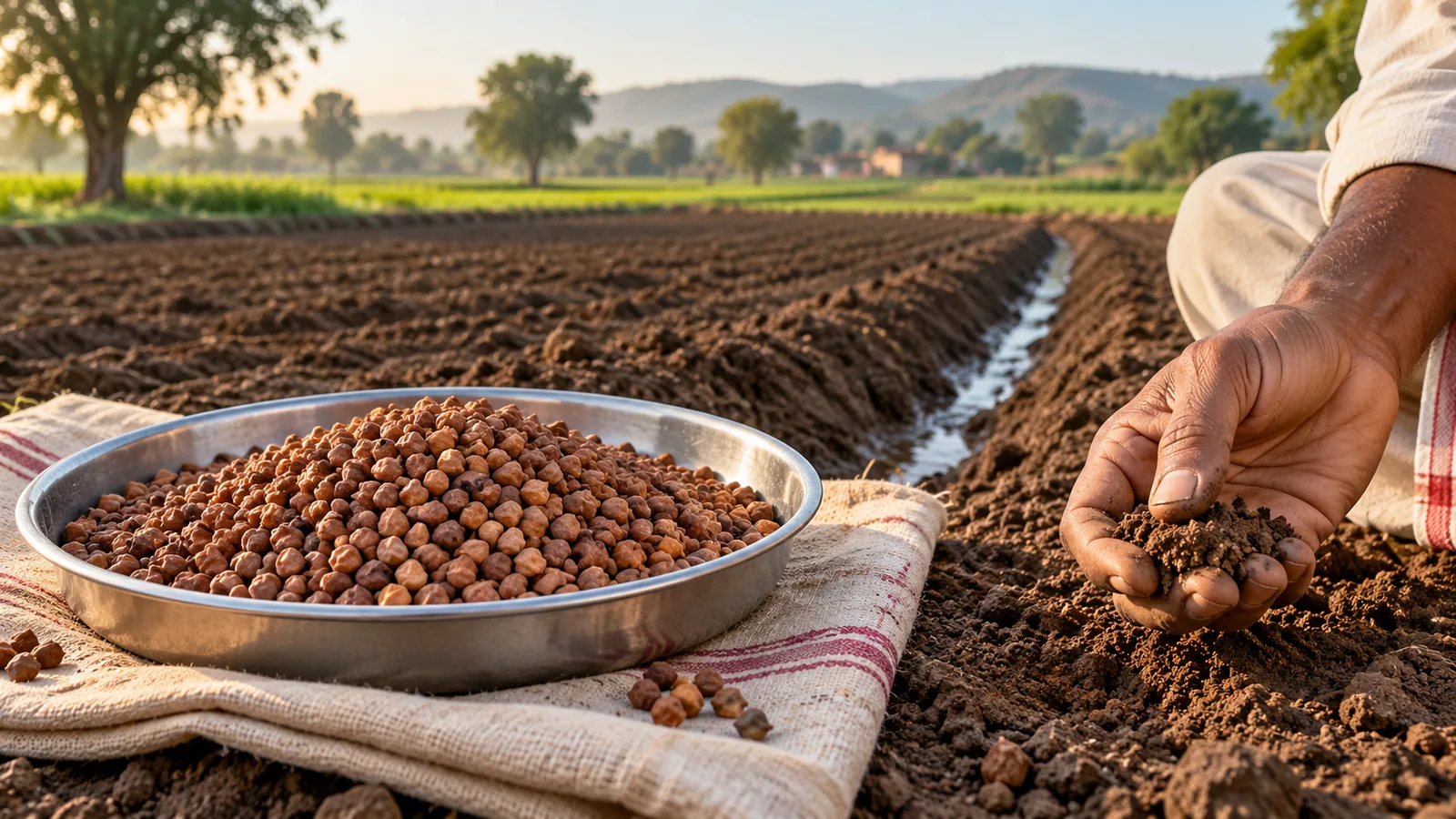
Establish field conditions before sowing chickpea
A chickpea plan is not complete simply because November has arrived or a mandi price looks attractive. First record whether the crop is intended for dry grain or green chickpeas, when the field will become available, whether the seed-placement layer has moisture and where water could come from if needed. This guide mainly covers sowing preparation for dry-grain chickpea; chana dal and gram flour are not substitutes for seed.
An example of regional advice issued on 30 October
IMD's national agrometeorological bulletin of 30 October 2026, valid for 30 October–3 November 2026, advises preparing chickpea and wheat fields in Madhya Pradesh's Middle Narmada Valley and sowing after rain subsides. In the same bulletin, chickpea sowing in North Gujarat is indicated from the first week of November. These are examples for the named regions, not nationwide instructions.
This bulletin link may later show a newer issue. Before booking machinery, check the issue date, validity and region in the latest advice for your district. Do not infer new rainfall conditions from an old bulletin date.
Examine moisture and standing water separately
Do not decide only from the field boundary. Note conditions in higher, typical and lower parts separately. With a local agricultural adviser or an experienced machine operator, check moisture in the layer where seed will be placed; a dry surface crust or wet shine alone does not describe the whole field.
| What is visible in the field? | Next task before booking sowing |
|---|---|
| Standing water or a blocked drain | Identify the drainage obstruction; after water drains and the field becomes suitable, agree on timing using local advice. |
| Moisture is present but varies between areas | Keep a sketch or photographs of the areas; ask whether one machine setting will suit the whole field. |
| Soil is dry and water is uncertain | Review actual water availability and crop options first; do not sow merely because seed has already been purchased. |
ICAR-CRIDA's district contingency plans distinguish soil, irrigation, sowing windows and situations with too little or too much rain. Use the reference for your district.
Clarify what “less water” means when choosing a variety
Instead of asking a seller only for “good chickpea seed”, explain the district, likely sowing time, previous crop and irrigation availability. Keep desi and kabuli chickpea market identities separate. A yield claim from another state does not establish suitability for your field.
For example, ICAR's information on Pusa JG 16 links it to drought-affected conditions in the Central Zone, which includes Chhattisgarh. This is an example of matching region and conditions, not a recommendation that every farmer buy this variety. Check local seed availability, the full variety name and current recommendations separately.
Do not calculate seed quantity from a fixed number of bags
TNAU's Bengalgram production guide gives details for named conditions and varieties in Tamil Nadu; even its seed rates for CO 3 and CO 4 differ. Do not adopt an online figure without matching it to your variety and region.
Record your area in one unit. If the locally recommended rate is per hectare, convert the area to hectares before calculating:
Seed required = area to be sown × seed rate confirmed for your conditions.
Before purchasing, check the variety, lot number, testing/packing details, available germination information, seller and receipt. If using saved seed, ask the local centre how to assess purity, storage condition and germination.
Do not mix several seed treatments on your own
Check the packet to see whether the seed has already been treated. Do not use treated seed for food, animal feed or household grain. Keep it away from children and food, and follow the label's safe-use instructions.
The TNAU guide explains chemical treatment, biological-control agents and Rhizobium procedures separately; it also notes incompatibility between some chemical fungicides and biological-control agents. Do not assume that everything can be mixed together. Confirm with a local agricultural specialist which product is needed, its currently permitted use on chickpea, treatment sequence and label quantity. This article gives no universal chemical dose.
Keep a short record of the previous crop and problems
Before selecting seed, record the previous two crops, places where plants wilted, areas with standing water and earlier treatments. Wilting alone should not lead you to name a disease yourself. Ask the local centre whether the field history calls for a change in crop rotation, variety, drainage or other preparation. Do not repeat the same crop only in the hope that changing seed will solve every problem this time.
Prepare the cost and sale records now
List seed, field preparation, sowing, the confirmed nutrition plan, available irrigation, labour and harvesting costs separately. Do not commit all your money on the assumption that future yield and price are certain.
Read recorded whole chickpea mandi prices and kabuli chickpea prices separately. The retail price of chana dal is not directly the farm's sale price for whole chickpeas. At sale time, match the record date, variety and grade before using the sale calculation tool (Hindi). If the field is still to become available after paddy, first read the guide to rabi options in Chhattisgarh (Hindi).
Five final checks before sowing
- The district's current advice has been matched to your variety's conditions.
- Moisture, drainage and available water have been assessed in the field rather than assumed.
- The units for area, seed rate and quantity purchased agree.
- A check of seed-placement settings has been arranged with the machine operator.
- The seed label, purchase receipt and a place to record sowing date and costs are ready.