
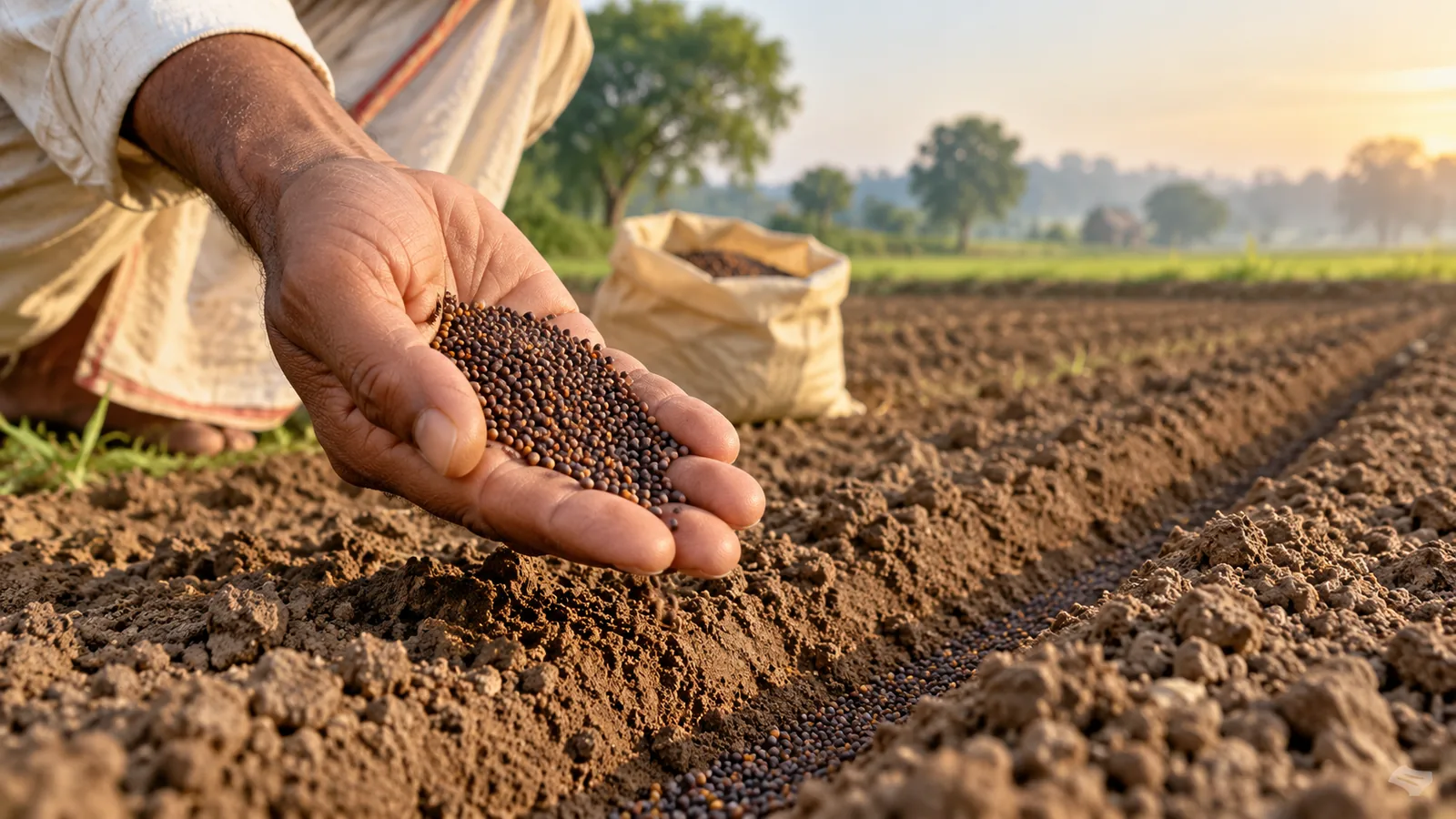
The first question in a mustard plan: what are your field conditions?
Before buying mustard seed for the rabi season, write down four things: your district, the previous crop, the likely date when the field will be ready and the irrigation actually available. A good mandi price or a report of high yields from a variety in another district is not enough. This guide covers preparation for growing Indian mustard for seed; it does not give one common sowing plan for mustard oil, yellow sarson or toria.
The official variety entries below are examples for planning. They are not new 2026 announcements or a list of seed currently in stock.
1. Keep rai, yellow sarson and toria distinct
The ICAR mustard research institute's crop introduction explains that the rapeseed–mustard group includes Indian mustard, toria, yellow sarson, gobhi sarson and other types. Instead of simply asking a seller for “good mustard seed”, obtain the crop type, full variety name and packet details.
Keep the identity of each variety's seed lot separate. Use local sowing advice and mandi records for that crop; do not identify it from grain colour alone.
2. Read the region and water conditions before the yield figure
The institute's variety list describes Indian mustard entries for different production conditions. These examples show why that distinction matters:
| Example from the official list | Recorded conditions | What should the farmer match? |
|---|---|---|
| DRMRCI (Q) 172 / BPM Q 172; notification year 2025 | Timely sowing, irrigated; Zone III includes Rajasthan, Uttar Pradesh, Madhya Pradesh, Uttarakhand and Bihar | Your region, timing and dependable irrigation |
| BPM 11; notification year 2024 | Late sowing; mustard-growing areas in Zone III listed in the source | The late-sowing situation and suitability for your district |
| DRMR 150-35; notification year 2020 | Rainfed conditions; the listed Zone V states include Chhattisgarh | Local rainfed advice and moisture available in the field |
These are examples of how to compare entries, not a shopping list. “New seed” or a maximum-yield figure does not guarantee a better result. Confirm the variety and conditions with the local Krishi Vigyan Kendra; retain the seed label and receipt.
3. If mustard will follow paddy, record when the field will become available
In Chhattisgarh and other paddy-growing areas, saying “a rabi crop after paddy” is not a complete plan. Allow separately for harvesting, residue handling, machinery access and the time needed to make the field suitable for sowing. Writing a date in a calendar does not make a very wet field ready.
Check where water collects, where it can drain and whether moisture is uniform across the field, then seek local advice. If paddy harvest is delayed, do not apply a variety's timely-sowing recommendation to late sowing without checking it. For an initial comparison of options, read preparing for rabi crops after paddy (Hindi).
4. Count the tasks in field preparation, not only the number of tillage passes
The institute's developed technologies describe different options for tillage, ridge/furrow arrangements, irrigation and nutrition. Research benefits reported there do not promise the same saving or yield on every field. Useful questions for your own field include:
- How will you manage the previous crop's residues, and under what conditions can the sowing machine work?
- Which local recommendation will determine seed depth, row spacing and machine settings?
- How will water drain from the parts where it collects?
- If irrigation is available, what are its source, timing and arrangements for reaching the field?
- Are soil-test results and records of nutrients already applied available?
The importance of sulphur and other nutrients for mustard does not justify applying the same fertiliser mixture everywhere without testing. Confirm quantities and sources through local recommendations. If seed is already treated, read its label; do not repeat treatment or mix different products without confirmation.
5. Fill in a short preparation sheet before sowing
| Item to record | Your information |
|---|---|
| District, village and field | Identity and location |
| Area | Acres or hectares—state the unit clearly |
| Previous crop and field-availability date | Actual condition alongside the estimate |
| Crop type and full variety name | Packet and lot details |
| Irrigation and soil moisture | Available sources and limitations |
| Machine, seed quantity and sowing settings | Values confirmed through local advice |
| Seed, sowing, labour and water costs | When payment will be needed |
Show this sheet to a local agricultural adviser. Do not write an undecided quantity or date as though it were a confirmed recommendation.
6. Check both district and validity period in weather advice
The institute's agrometeorological advisory service offers district selection for Alwar, Bharatpur, Dholpur, Karauli and Sawai Madhopur in Rajasthan. A Bharatpur bulletin is not a warning for Raipur or another district. Before sharing a bulletin, read its district, issue date and validity period.
A possibility of rain is not certain rainfall, and an old advisory screenshot should not be applied to current conditions. The guide to using a forecast for farm work (Hindi) explains how to read a bulletin. This article does not issue a current weather warning or an instruction to stop irrigation.
7. Prepare for selling without treating the next harvest's price as fixed
Check the date and market in recorded mustard mandi prices. Current records do not promise a price for the next harvest. Record costs from seed and sowing through irrigation, harvesting and sale. Later, when choosing a mandi, enter your quantity, the buyer's actual offer, transport charges and deductions in the sale calculation tool (Hindi).
Next task: complete the preparation sheet and confirm the variety and sowing conditions. Then arrange the seed and machinery.