
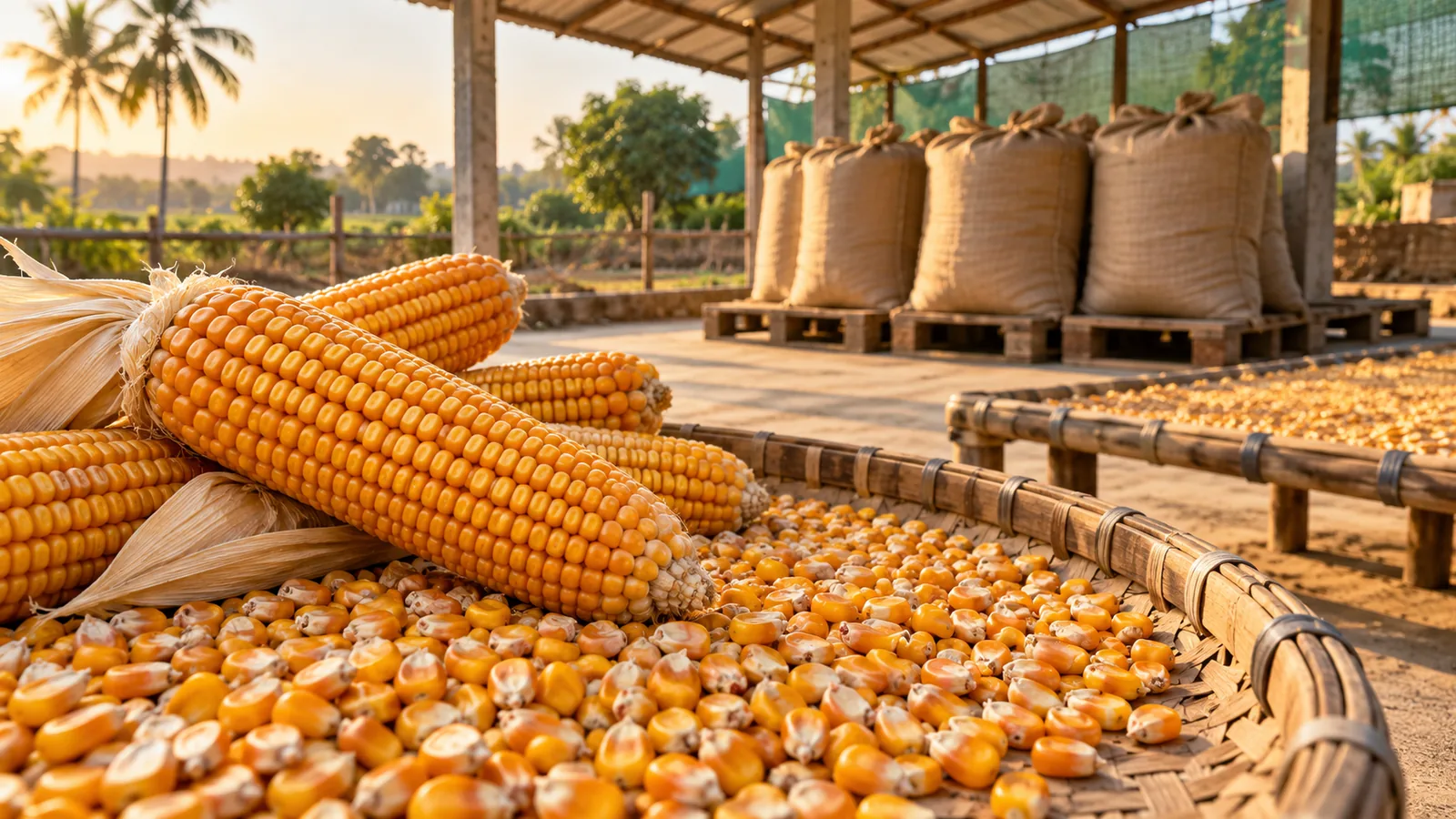
After harvesting kharif maize, ask one question before focusing on a high mandi price: is your lot ready at the weight and quality for which the buyer will pay? Weight changes as moisture falls; removing damaged grain, drying and transport also add costs. Do not treat the quantity leaving the field as the final sale quantity automatically.
This guide is for mature maize grain intended as food grain. Fresh green cobs, sweet corn, baby corn and silage require different handling. If saving seed for sowing, seek separate advice on germination and drying procedures. This is a seasonal preparation guide, not today's weather bulletin for your district.
First, record the lot's identity
On a slip or phone note, record the field/lot, variety, harvest date, whether it is cobs or shelled grain, any wetting and the estimated quantity. Mixing lots from different dates, with different moisture or questionable condition without identifying them makes later checks and accounting harder.
TNAU's maize production guide mentions yellowing cob husks and hard, dry kernels at maturity. It also describes cleaning after shelling and bagging dry grain. Read this alongside moisture checks from your own field; colour alone does not establish storage readiness for the whole lot.
Harvest moisture and storage moisture are different
TNAU's harvesting criteria table mentions about 22–25% moisture in the context of maize harvest, while its general safe-storage table gives 12% for maize. Being ready to harvest therefore does not mean being ready for long storage immediately.
Do not treat 12% as a certificate for every situation. Agree on the target with local quality staff according to storage duration, intended use, temperature, packaging and available facilities. This figure comes from an older technical reference; it is not a 2026 government procurement limit or a buyer's current acceptance standard. Ask separately about the procurement centre's moisture limit and other conditions.
Confirm arrangements before drying
Check for a clean drying area, rain protection, labour and arrangements to turn and gather the grain. For mechanical drying, tell the service provider the grain's condition and final use in advance. Do not set a dryer's temperature or operating time from this article.
- Is the charge based on wet weight or weight after drying?
- Who will sample and measure moisture, and with which instrument?
- Are cleaning, shelling and bagging included in the charge?
- How long is the wait, and where will the lot be kept meanwhile?
- When will the finished weight and moisture be supplied in writing?
Have checks performed with a properly functioning moisture meter suitable for maize, following its method. Ask the centre to help obtain a representative sample; do not record a reading from grain taken only from the top of one bag as the result for the entire lot. Note the testing time and instrument/centre. If readings differ between parts, have them checked again.
Do not mix a mouldy lot with clean grain
The US FDA's mycotoxin reference describes toxins produced by some moulds in maize and their risks in both food and animal feed. It is used here to explain the risk; US standards do not replace Indian procurement rules.
Identify and separate portions with mould, unusual smell, colour or heat, and obtain appropriate quality checks. Mixing them into clean grain to hide the problem, or assuming they are suitable for animal feed without assessment, is not appropriate. An ordinary moisture reading is a different check, not a mycotoxin test. Do not carry out a home pesticide or fumigant treatment on the basis of this article.
Lower weight after drying does not always mean missing grain
Consider a hypothetical arithmetic example: 1,000 kg of grain has 18% moisture. If only water is removed, dry matter is unchanged and final moisture is 12%, the estimated weight is:
1,000 × (100 − 18) ÷ (100 − 12) ≈ 932 kg
A difference of about 68 kg can therefore come from water loss. This is an ideal calculation, not a substitute for actual weighing. Record cleaning waste, broken grain, spillage and other losses separately. The final moisture target must be chosen for the actual storage arrangement.
Obtain five points in writing before sending grain to market
- Does the buyer want dry grain or cobs, and what are the variety and final use?
- What are the acceptance conditions for moisture, foreign material and broken/damaged grain?
- Where will the sample be tested, and what is the retesting procedure if there is a disagreement?
- In which unit and on which accepted weight will the price be paid?
- What are the conditions for weighing, deductions, transport, labour and payment?
Check the record date and variety in recorded maize mandi prices. Obtain an actual offer for your lot before using the sale calculation tool (Hindi). Even with a higher price, a lower accepted weight and extra costs can reduce the money you receive. Match both parties' details using the weighing, deductions and payment checklist (Hindi).
A short answer: store it or sell now?
Consider the actual offer available today, drying/storage facilities, total extra costs and your payment needs together. Do not calculate on the assumption that a higher future price is certain. Changing the sale date alone does not resolve questionable quality; arrange checks and safe handling first.